
How can we respond to the relentless and often terrifying advance of AI in a way that protects state sovereignty and redistributes wealth at the same time?
tldr: this blog sets out a new, radical, but necessary plan to curb the excesses of AI proliferation and equitably distribute the power and resources generated by AI capacity amongst the people of the world. It proposes an AI Commons framework to both manage and distribute the compute capacity required to run frontier AI models, and a global licensing system to generate finance for the world's poorest people and nations, ideally paid out as direct cash dividends.
By Patrick Brown, November 2026
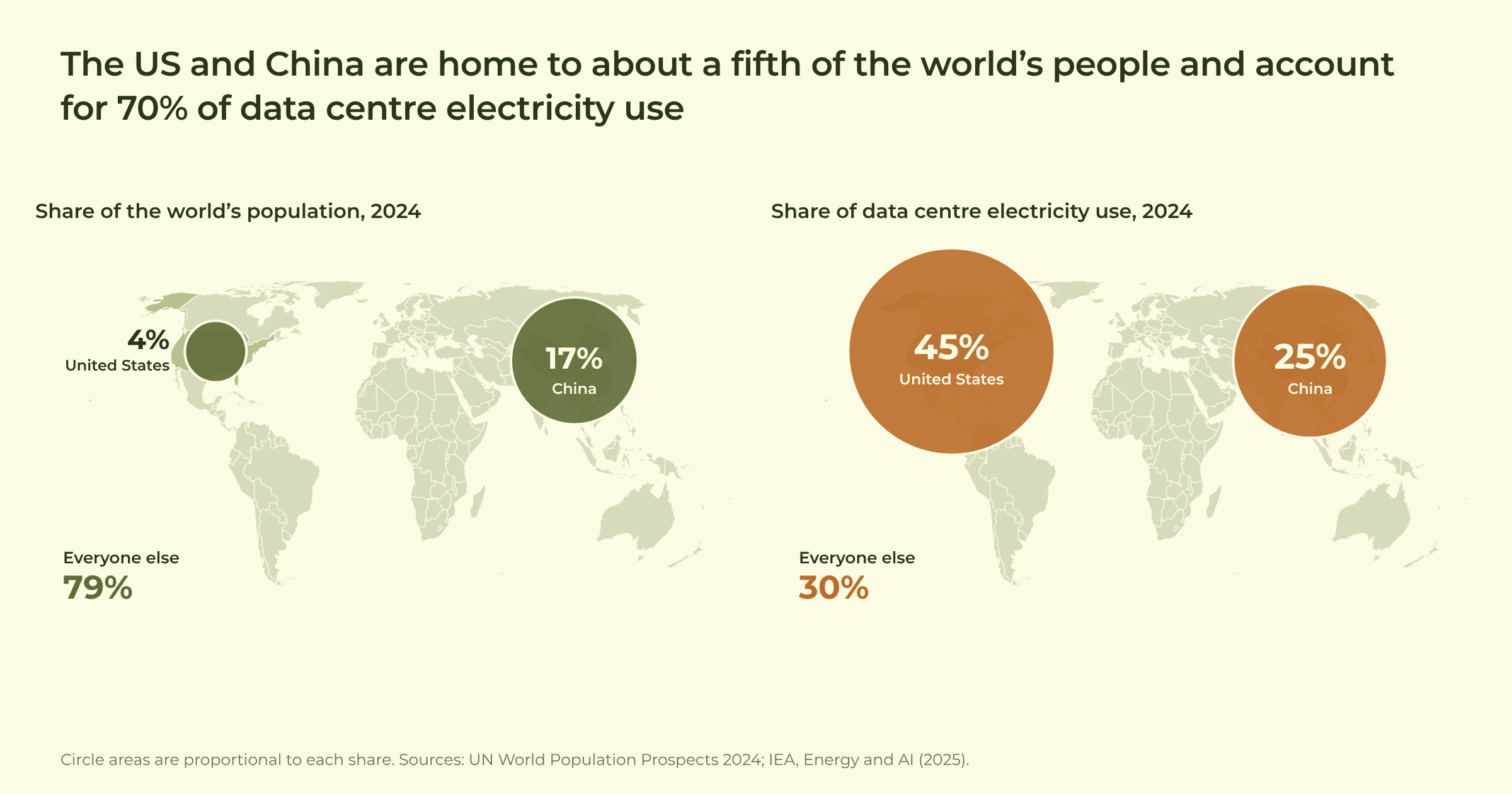
Africa is home to around 18% of the world’s population and holds just 0.6% of its data centre capacity. The US is home to 4% of the population and accounts for around 45% of data centres. Around $5.2 trillion is expected to be spent on AI data centres in the next four years. That's more than $600 for every person in the world, and enough to cover the estimated cost of ending extreme poverty for 16 years. Yet the vast majority of the value it creates will accrue in ways that reflect and reinforce global inequality.
Whatever the term preferred - Compute Colonialism, Data Colonialism, AI Colonialism - AI and its supply chains are unusually predisposed to accelerate inequitable capital accumulation. Imagine you’re a developing country that’s using the latest frontier model from OpenAI. AI will likely replace a rising share of your small but growing middle class, the knowledge workers who are the backbone of an emerging economy.
This depletes your tax base and raises pressure on already insufficient social protection systems and public services. If you try to tax these AI behemoths, you may find they have little in your country to actually tax. If you try to sanction them, they could pull a kill switch that sends shockwaves through your economy. Unlike the oil or minerals you can sell to the developed world, which whilst harmful still generate real revenue, you have next to no leverage in the AI supply chain.
Part of the challenge is that the latest AI models are not a physical asset like oil or minerals, so their ownership and value can be hyper-centralised at the core of a new AI empire, most likely in the US or possibly China. But the hyper-mobility of AI models and their lack of physical presence also give us a golden opportunity to redefine what AI actually is, and explore new understandings of shared, common wealth.
AI is built from a collated, analysed, codified and tokenised compilation of much of recorded human knowledge and history. It is an endowment that belongs equally to each and every one of us. We all contributed to its existence, and therefore we deserve a share of its value.
This is the first key provocation: AI is part of our common wealth, and its value ought to be equally distributed.
Second, because AI proliferation is very likely to fundamentally reshape our economies, upend labour markets, and concentrate capital in the hands of the few, we urgently need new, fit-for-purpose redistributive mechanisms to support people during this upheaval.
Third, many of those building frontier models themselves warn that AI could pose an existential risk to humanity, and new models of multilateral engagement, cooperation and regulation, alongside protections for national sovereignty, are essential to safeguard our very existence.
These three provocations provide the foundation for what we now set out: a global Cap and Share policy to limit AI risk and share AI wealth among the people of the world.
The spark for this blog came from reading AI 2040: Plan A, by Thomas Larsen and colleagues at the AI Futures Project, and it borrows from the modelling behind their Citizen’s Dividend concept. Equal Right’s own Cap and Share proposals, themselves inspired by organisations such as Feasta, provide the conceptual foundation the idea is built upon.
There are now many solid proposals on how to regulate and manage the AI boom, including Bernie Sanders’s American AI sovereign wealth fund, Anna Yelizarova’s global dividend fund, the Windfall Clause and Sam Lyman’s data centre dividends. The difficulty with most of these proposals is that they stop at a national border, or set out to tax intangible or highly mobile assets, limiting their redistributive and revenue-raising potential. This proposal sets out a new path.

In June, Sen. Bernie Sanders (Ind, VT) unveiled plans to give the US Government an equity stake in major AI companies.
Here’s the idea, in four steps:
Nations of the world agree a cap on AI compute - the total processing capacity of all AI chips in use in data centres globally.
Licences to use that compute are shared out to every country in the world, on an equal per capita basis.
Nation states decide whether to sell their licences to the highest bidding governments, or use them to develop their own AI capacity. A minimum price per unit of chip capacity sets a price floor; the market decides the ceiling.
Revenues raised are paid into national budgets, and ideally invested in sovereign wealth funds, social protection systems and universal dividends.
What is Compute Colonialism?
Compute colonialism describes a world in which a handful of countries own the chips, data centres and models that produce AI, receiving most of the benefits, and everyone else rents access to them, receiving little. Exposure to AI may be highest in Western knowledge economies, but the productivity gains are also greatest there, and social protection systems are well embedded. In developing nations, entry-level white-collar jobs, often a route into decent work and the middle class, are at risk of disappearing before anything can replace them, which a joint ILO and World Bank paper calls a ‘white-collar bypass’.
Consider India's IT and business process management industry, which employs almost 6 million people and earns revenues equal to around 8% of Indian GDP. Or the Philippine outsourcing sector, employing 1.9 million people and earning $40bn in 2025. Both industries were built on precisely the routine, digitised, English-language work that current models handle well.
Weak infrastructure, poor connectivity and lower education levels mean any AI gains are likely to be unrealised or highly concentrated. 3.8 billion people worldwide have no social protection of any kind, and only 9.7% of people in low-income countries are covered. Attempts to regulate AI in these countries are likely to be met with threats to withdraw services or investment, leaving governments at the back of the development queue, while ‘broligarchs’ continue to draw more and more value from the southern periphery to the Silicon Valley core.
No amount of domestic policy will offset this - an African nation attempting to regulate AI on its own would be as futile as Montezuma attempting to regulate the Spanish Empire.
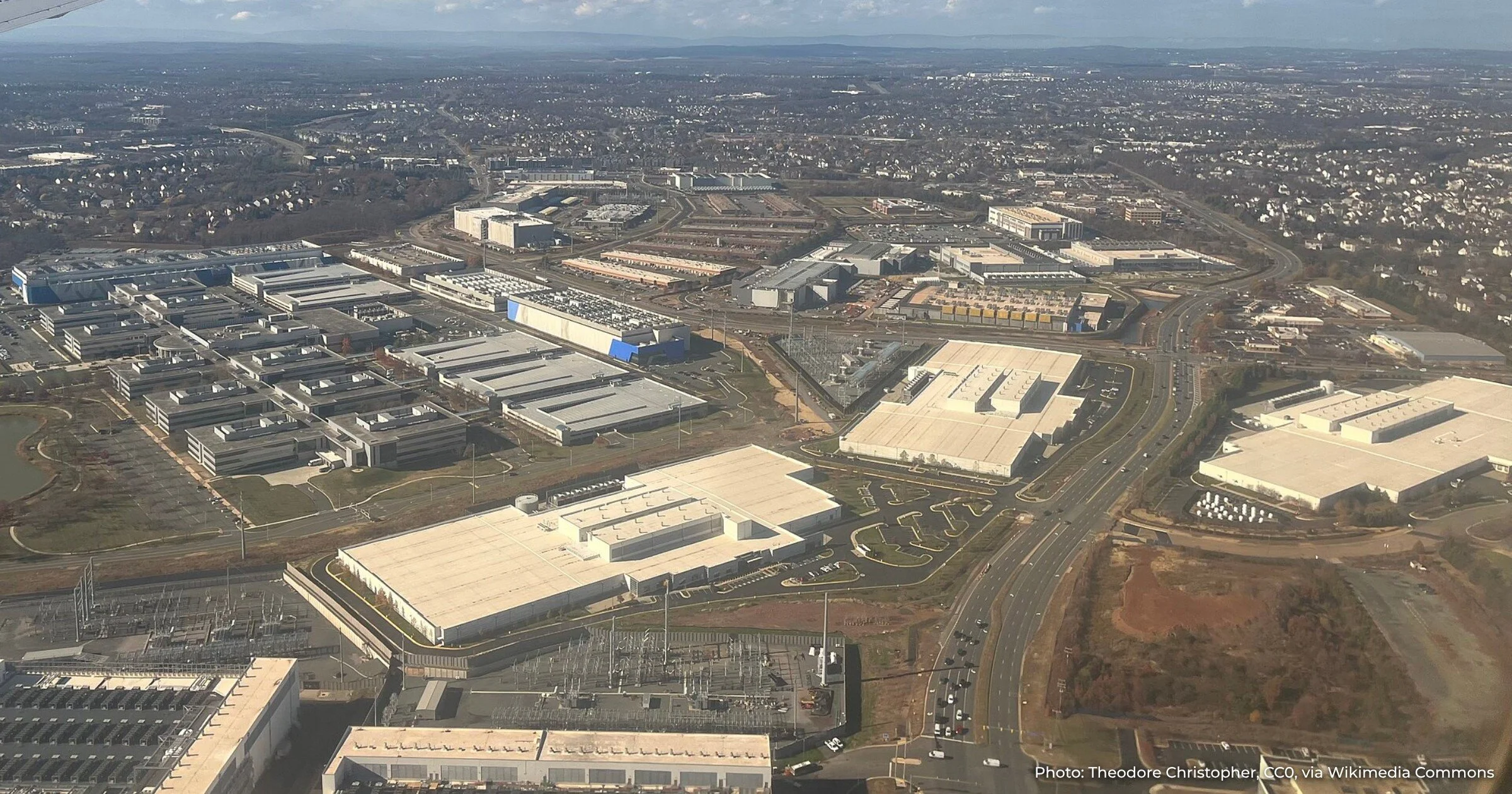
An aerial view of data centres in Ashburn, VA, USA
How does the AI Commons work?
The idea that everyone has an equal right to a share of the commons is not new. Thomas Spence, in ‘The Rights of Infants’ (1797), proposed that land be held in common by each parish, with parish committees collecting the rents, paying for public services first and sharing the rest equally among every resident, including children. The AI Commons adopts a similar premise, with nation states replacing the parishes and AI replacing the agricultural economy of Spence’s era.
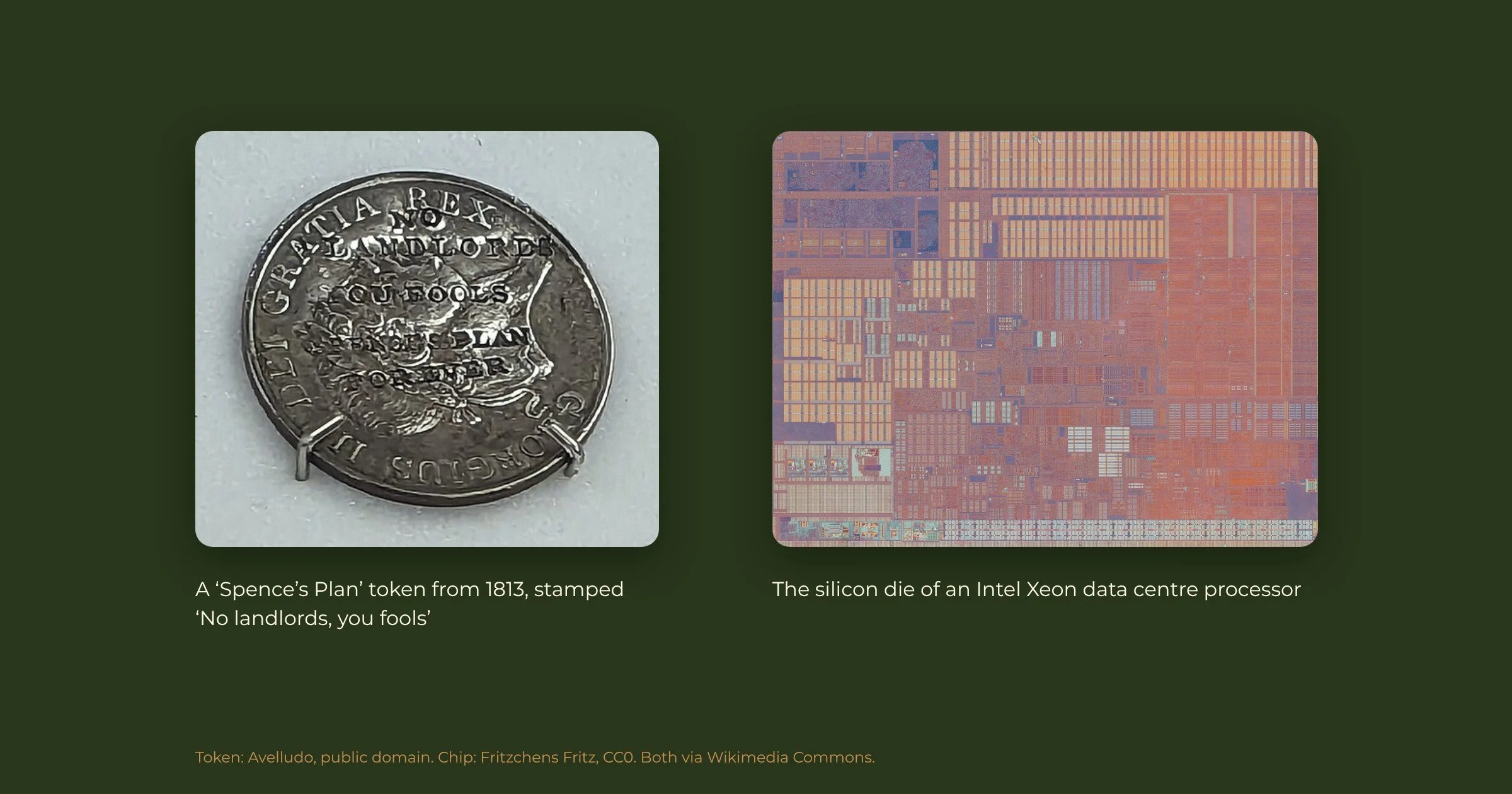
Where Spence used land as the basis for his commoning, we use compute, understood as the processing performance, or work capacity, of physical AI chips. Many existing proposals attach revenues to corporate profits or share values, through windfall taxes, public equity stakes or automation levies. We are sceptical of the long-term viability of any of these. Profit, especially AI profit, is inherently mobile in the modern economy, creating a game of whack-a-mole for regulators and an incentive for some countries to undercut the rest (looking at you, Argentina). And that’s even if we assume AI companies will be profitable in the traditional sense any time soon - OpenAI is expected to spend around $22bn against $13bn of revenue in 2025, and does not expect to turn a profit until around 2030.
Compute is different because it can actually be found, counted and therefore more easily taxed. AI runs on specialised chips that are exceptionally difficult to make and pass through a narrow supply chain. The lithography machines that print the most advanced circuits are built by one company in the Netherlands, ASML. The optics inside them come from Zeiss and the lasers from TRUMPF, both German firms. One company in Taiwan, TSMC, manufactures around 90% of the world’s most advanced chips. Japan supplies more than half of the world’s silicon wafers, and South Korea supplies more than 80% of the high-bandwidth memory that every AI chip needs. Whilst governments globally are attempting to broaden this supply chain, a number of critical chokepoints remain, and they depend on physical and traceable inputs.
Under US export controls, every advanced AI chip has a performance score, called Total Processing Performance, calculated from its processing power and precision. For example, an Nvidia A100 chip scores about 5,000 on this measure, and its H100 chip about 15,800. The measure is set by the US Commerce Department’s Bureau of Industry and Security, and exporters calculate it to find out whether a chip needs an export licence. The means to quantify and track compute - the building blocks of any reliable tax base - therefore already exist at the point of export.

Silicon Wafer
A licence would have a price floor per unit of performance score rather than per chip. This ensures that revenues keep pace with advances in chip capacity, whilst still anchoring revenues to a physical product (chips). Setting that price floor, and agreeing the total amount of licensed annual compute, is beyond the scope of this article and would be subject to (intense) international negotiation.
Licences would be sold annually. Multi-year deals could be allowed, so that developing countries can receive more capital up front, but only for a limited term: a share of the AI Commons is a permanent right, and no government should be able to sell it on behalf of its successors. Countries could choose to sell their licences one year and withhold them the next, increasing the bargaining power of poorer nations and creating new models of international cooperation. For example, a rich country might find it cheaper to help a country with spare licences build its own data centres, and share access to that capacity, than to pay an annual licence fee.
A key contribution of the AI Commons model is a fair rule for sharing compute between countries. Plan A’s own proposals leave the US owning around 35% of the world’s AI compute in 2040 and China 20%, with the remaining 45% for the other four-fifths of humanity. The AI Commons starts from a bounded quantity - the cap - that limits the total number of licences that can be used or sold. The cap makes licensing quantifiable, and it is also a tool for controlling the pace of the fourth industrial revolution - countries could agree to loosen or tighten it.
The per capita rule aims for fairness and safeguards sovereignty in an inequitable and increasingly unstable international system, whilst recognising that no perfect solution exists. Granting licences on a per capita basis is the cleanest expression of the principles underpinning the AI Commons, and it ensures that populous countries with little compute of their own gain the most, allowing countries like Nigeria, the Philippines, Brazil and India (to name just a few) to become major players.
Would countries actually sign up to this?
The per capita rule gives China, at least, a reason to take part: it would receive about 17% of licences, more than its share of the world’s AI compute, which Plan A projects at around 9% by 2029. The US would not gain in the same way, because it would receive about 4% of licences while owning around three-quarters of that compute. Alternative options, such as weighting licences by national income (in favour of poorer countries) or climate vulnerability, or time-limited grandfathering for current AI leaders, could be negotiated on top of the per capita foundation.
The obvious objection to this idea is that the US, as the world’s largest holder of compute (and therefore the largest net contributor in a licence-based system), would never sign up. But the AI Commons doesn’t have to start with the US. As described above, a group of middle powers are crucial to global AI supply chains.
These nations hold significant leverage, and also have knowledge economies that are highly exposed to AI, giving them a reason to lead a coalition of the willing to shape a new global policy framework. And if, for example, they made enrollment in the AI Commons a condition of maintaining vital parts of the AI supply chain, they could put increasing pressure on the bigger players (the US and China) to join.
How much could it raise, and how would the money be used?
We have not set a price per unit of chip capacity here, only the principle of a price floor, and will explore where it should sit in future writing. Plan A gives some sense of the range, estimating that around $800 billion will be spent on AI hardware and data centres in 2026, so a licence that added 10% to that cost would raise around $80 billion a year. At the other extreme, in its scenario of an AI economy growing by around 90% a year, compute permits raise around $37 trillion a year in the United States alone by 2032. Where the real figure falls depends on the rate of AI advancement and on how tight the cap is.
At the lower level, an equal per capita share would send around $7 billion a year to low-income countries, about 2% of what the ILO says is needed to build a universal social protection floor. That would be a modest start. If AI proves as transformative as many advocates claim, the numbers change dramatically. Plan A’s authors project a dividend of roughly $1 million a year for every American by 2035. The same pot, shared equally among everyone on earth under our model, would be worth around $40,000 per person. We would rather not build a campaign on a forecast that ambitious and speculative, but the potential, and the imperative to do something about it, are clear.
Regardless of the amount, the money raised from the sale of licences should be used to underpin the social protection systems needed to safeguard populations from AI job displacement. Countries may wish to use revenues, especially from multi-year licence sales, to endow permanent funds that sustain payments indefinitely, as Alaska and the Marshall Islands have already done. They may opt to target social protection to vulnerable populations at the frontlines of the climate crisis, not least given the correlation between AI proliferation and climate impact. Ideally, to truly reflect the vision and intent of the AI Commons, distribution would take the form of an equal, unconditional dividend, or basic income, paid to every man, woman and child. This may not be possible in the early stages of the AI Commons, but it should be the long-term goal.
Why we need this:
Most proposals ask how to tax the value derived from AI, when we should be asking who owns it in the first place. Today’s large AI models were trained on the accumulated writing, code, art, culture, ideas and knowledge of billions of people who never consented and, with few exceptions, will never be paid for it either. Whether we live in Silicon Valley or the Amazon rainforest, it belongs to all of us. It is the largest and perhaps most consequential commons humanity has ever built, and there is still time to realise our equal right to it.
In the interests of transparency and in line with Equal Right’s AI Policy, we confirm that AI (specifically Claude Fable) was used to help research, proofread, and refine this article. The ideas, arguments and drafting are the authors' own, except where clearly cited otherwise.
